Woozoo Fan Wattage & Power Consumption: All Models Compared
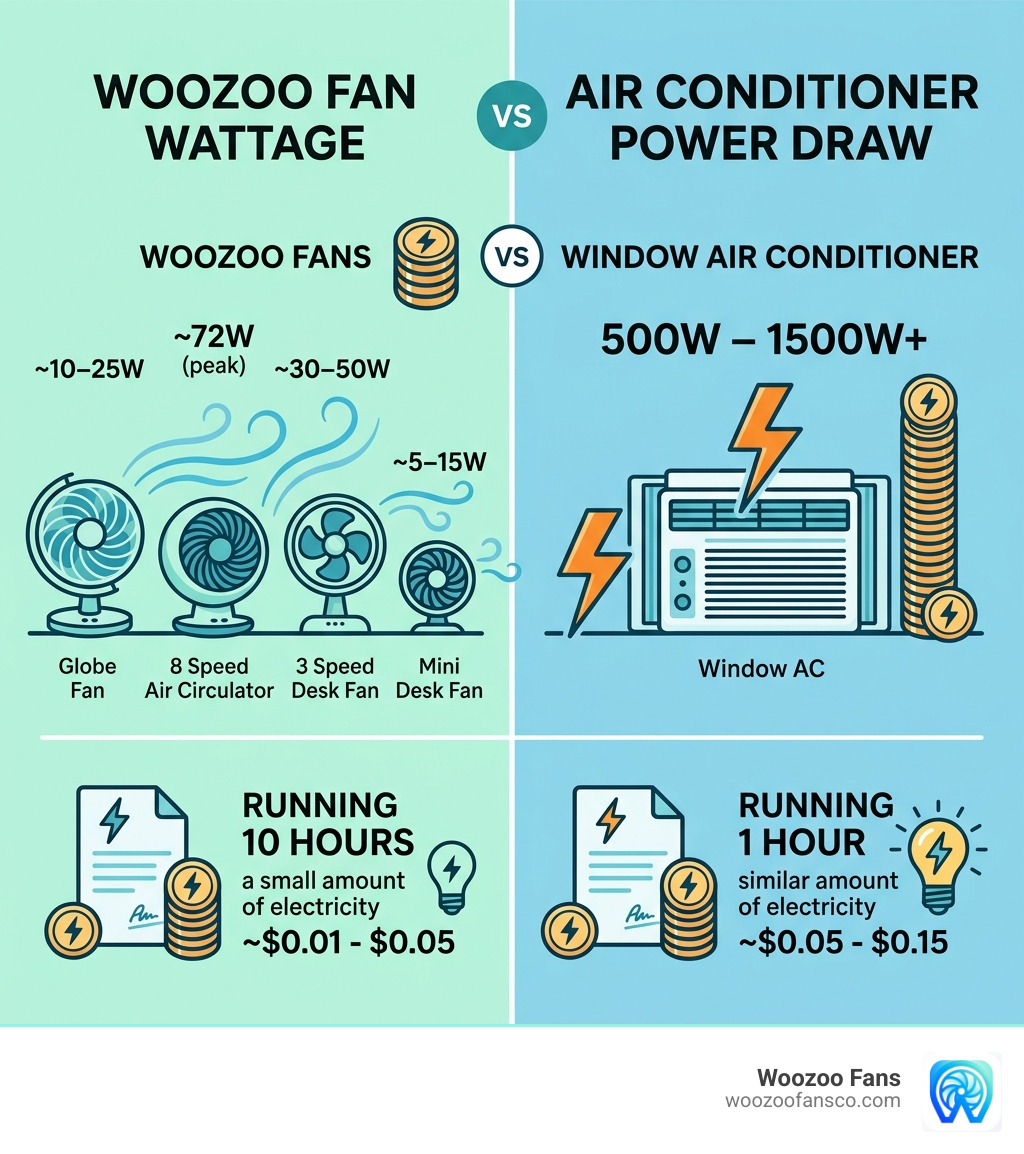
Woozoo fan wattage ranges from 5 watts on the Mini Desk Fan to 72 watts on the Globe Fan at peak speed. Woozoo fan power consumption costs between $0.54 and $2.25 per month for typical daily use. Every Woozoo model uses a fraction of the electricity a window air conditioner draws.
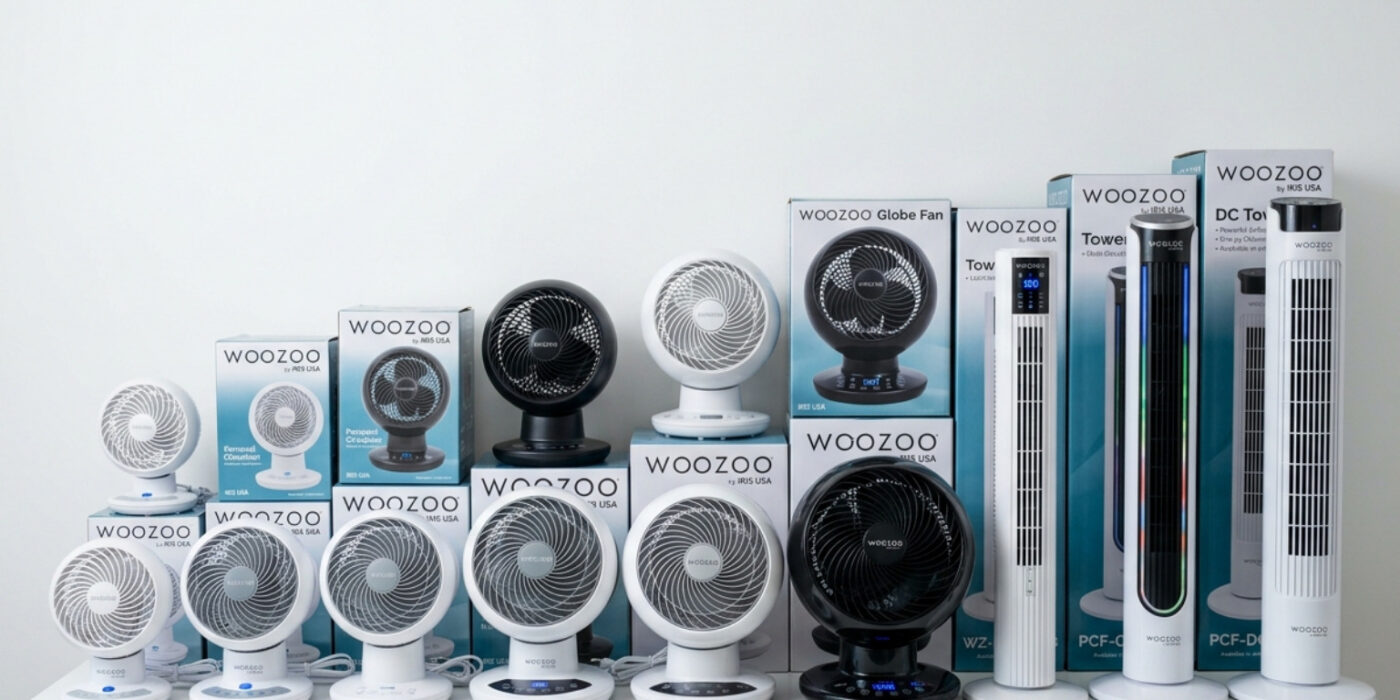
Here is the full Woozoo fan energy consumption breakdown across every model available as of May 2026:
| Model | Motor Type | Estimated Wattage | Speeds |
|---|---|---|---|
| Woozoo 5 Speed Air Circulator Fan | AC | ~72W (peak) | 5 |
| Woozoo Globe Fan 2024 | AC | ~72W (peak) | 5 |
| Woozoo 8 Speed Air Circulator DC Motor | DC | ~10–25W | 8 |
| Woozoo 3 Speed Desk Fan | AC | ~30–50W | 3 |
| Woozoo 3 Speed Desk Fan with Remote | AC | ~30–50W | 3 |
| Woozoo Mini Desk Fan | DC | ~5–15W | 3 |
| Woozoo Pedestal Fan | AC | ~40–60W | 3–5 |
| Woozoo Tower Fan | AC | ~45–55W | 3 |
| Woozoo Oscillating Fan | AC | ~35–45W | 3 |
Wattage varies by speed setting. DC motor models use up to 70% less energy than comparable AC motor fans, according to manufacturer specifications from IRIS USA.
A Woozoo fan running on medium speed for 10 hours consumes roughly 0.5 kWh. A window AC unit running for 10 hours consumes 10 kWh. The fan uses 95% less electricity over the same period.
This guide covers Woozoo fan wattage, Woozoo fan power consumption, monthly cost estimates, and efficiency differences across every model available as of May 2026.
Woozoo Fan Energy Consumption: How Vortex Technology Keeps Wattage Low
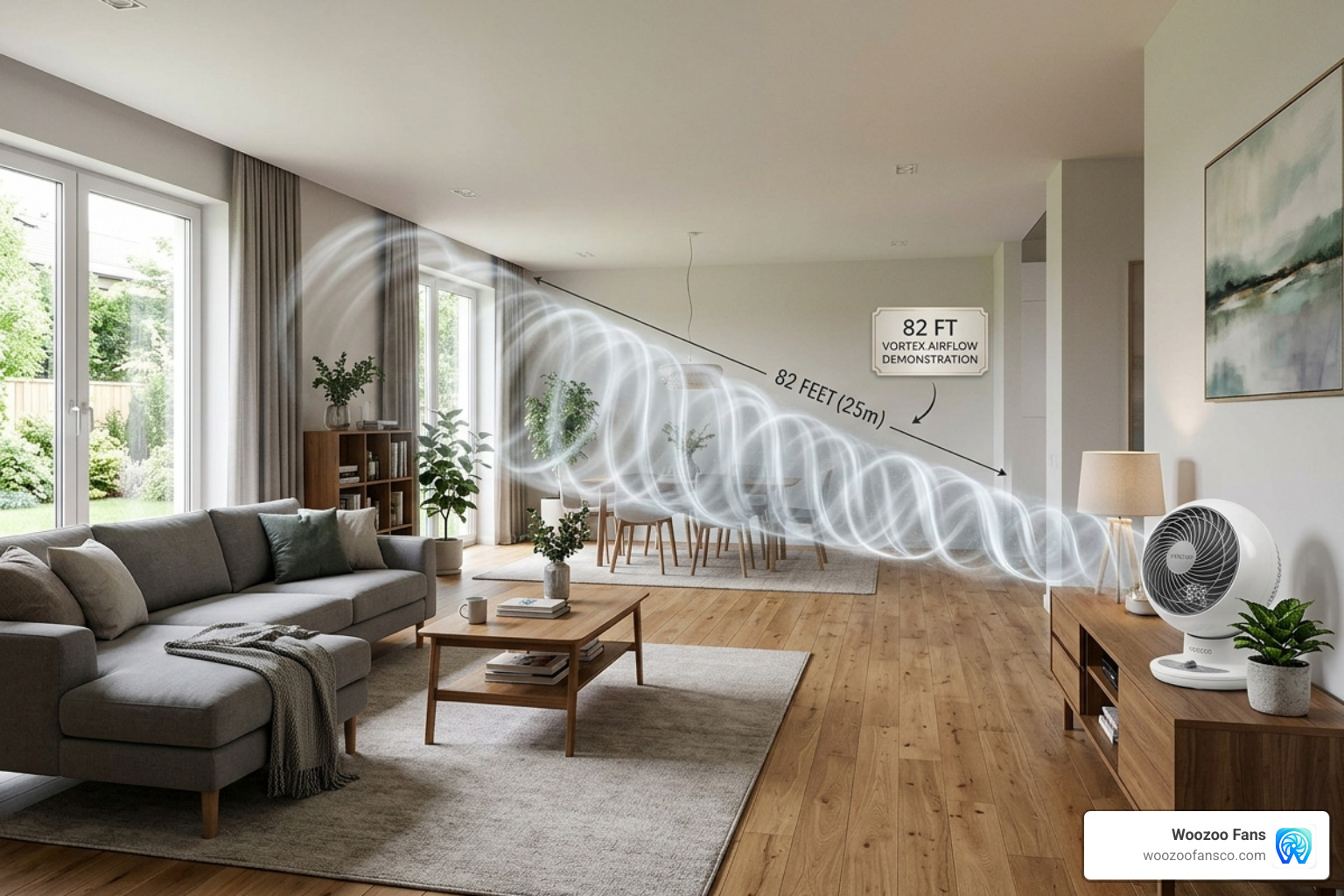
Woozoo fan energy consumption stays low because of the vortex airflow design. Each fan uses a deep-pitch blade and a spiral grille. These create a concentrated column of air that travels up to 82 feet. The fan circulates air through the entire room. You do not need to run the fan at maximum speed to feel the breeze. Running at lower speeds keeps Woozoo fan power consumption minimal.
Woozoo fans use two motor types: AC (Alternating Current) and DC (Direct Current). AC motors are standard in most household fans. DC brushless motors are newer and more efficient. The DC motor in the Woozoo 8-Speed model draws roughly 18 watts at peak speed. A comparable AC motor fan draws 60 watts or more. The DC motor also runs quieter. The Woozoo DC model operates at 26 decibels on its lowest setting. The AC Globe Fan operates at 30 decibels.
AC Motor vs. DC Motor Efficiency
DC brushless motors reduce Woozoo fan energy consumption by up to 70% compared to AC motors. The Woozoo 8 Speed Air Circulator DC Motor draws roughly 18 watts at peak speed. An equivalent AC motor fan draws 60 watts or more.
DC motors achieve higher efficiency through three design advantages:
- No brush friction. Brushless DC motors eliminate physical contact between brushes and commutator. Less friction means less energy lost as heat.
- Lower operating temperature. DC motors run cooler than AC motors. Heat is wasted electricity. A cooler motor converts more input power into blade rotation.
- More speed increments. The Woozoo DC model offers 8 speeds instead of the typical 3 or 5. Finer speed control lets you find the lowest setting that still provides adequate airflow.
According to IRIS USA, the manufacturer of Woozoo fans, DC motor models consume up to 70% less electricity than comparable AC motor fans. Running a Woozoo DC fan on medium speed for 24 hours costs approximately $1.74 per month at the national average electricity rate of 16.07 cents per kWh.
Factors Affecting Woozoo Fan Energy Consumption
Four factors determine Woozoo fan power consumption beyond the motor type:
- Speed setting. A Woozoo 5 Speed Air Circulator Fan draws approximately 10 to 15 watts on Speed 1. The same fan draws up to 72 watts on Speed 5. Lower speeds reduce Woozoo fan wattage by 80% or more.
- Oscillation. Horizontal and vertical oscillation motors add roughly 2 to 3 watts to the total power draw. This additional load is small relative to the main fan motor.
- Timer usage. Built-in 1, 2, and 4-hour timers prevent the fan from running in empty rooms. A fan that runs 4 hours instead of 10 hours uses 60% less electricity per day.
- LED display. Capacitive touch panels and LED indicators draw less than 1 watt. Models with an LED-off feature eliminate this draw entirely during sleep.
Woozoo Fan Wattage: Model-by-Model Power Specifications
Each Woozoo model has a specific wattage range. The table below lists peak wattage, best use case, and energy profile for the four most popular Woozoo fan models based on manufacturer specifications and retail listings.
| Model Reference | Peak Wattage | Best Use Case | Energy Profile |
|---|---|---|---|
| PCF-SC15T (Globe) | 72W | Medium/Large Rooms | High Performance |
| PCF-HD15 (Turbo) | 50W | Personal/Desk | Balanced |
| PCF-SDC15T (DC) | 25W | 24/7 Circulation | Ultra-Efficient |
| WZ-Mini | 15W | Nightstand/Office | Minimal |
High-Performance Models: Globe Fan and Pedestal Fan
The Woozoo Globe Fan 2024 (model PCF-SC15T) and the Woozoo Pedestal Fan move air across rooms up to 353 square feet. The Globe Fan has a peak Woozoo fan wattage of 72 watts. A standard 60-watt incandescent light bulb draws nearly the same power. The Globe Fan circulates air through an entire room for roughly the electricity cost of leaving one old-fashioned light bulb on.
The PCF-SC15T Globe Fan is rated 4.8 out of 5 stars across 390 verified reviews at Best Buy. It sells for $59.99. The fan operates at 30 decibels on its lowest setting. Read the full breakdown in the Woozoo 5 Speed Globe Fan Review.
Compact and Desk Fan Energy Usage
The Woozoo 3 Speed Desk Fan and the Woozoo 3 Speed Desk Fan with Remote operate between 30 and 50 watts. The Desk Fan with Remote runs at 23 decibels on low. It sells for $49.99 at Best Buy.
The Woozoo Mini Desk Fan draws 5 to 15 watts. Its Woozoo fan power consumption is the lowest in the lineup. The Woozoo Macaron Personal Fan sells for $24.99 and provides quiet personal cooling for desks and nightstands.
Woozoo Fan Power Consumption: Monthly Electricity Cost Calculator
Woozoo fan power consumption costs between $0.54 and $2.25 per month for typical daily use. The exact cost depends on the model, speed setting, hours of use, and your local electricity rate. The national average residential electricity rate is 16.07 cents per kWh as of May 2026, according to the U.S. Energy Information Administration.
A 50-watt Woozoo fan running 10 hours per day costs $2.41 per month at the national average rate:
- 50 watts × 10 hours = 500 watt-hours (0.5 kWh) per day.
- 0.5 kWh × 30 days = 15 kWh per month.
- 15 kWh × $0.1607 = $2.41 per month.
A window AC unit drawing 1,000 watts costs $48.21 per month for the same 10-hour daily usage. The Woozoo fan uses 95% less electricity. Choosing the Best Woozoo Fan Model for your room size reduces air conditioning hours and lowers your total cooling bill.
Woozoo Fan Energy Consumption: Cost Estimates by Usage Pattern
Woozoo fan electricity usage costs pennies per day across all models:
- 24/7 operation with a DC motor model. A Woozoo DC fan drawing 15 watts on medium speed costs $1.74 per month running continuously. Calculation: 15W × 24 hours × 30 days = 10.8 kWh. 10.8 kWh × $0.1607 = $1.74.
- Supplementing air conditioning. Running a Woozoo fan lets you raise the thermostat by 4 degrees Fahrenheit without losing comfort. The U.S. Department of Energy states that each degree reduces cooling costs by approximately 3%. A 4-degree adjustment saves roughly 12% on your cooling bill.
- Payback period. A $59.99 Globe Fan saves approximately $45 per month in avoided AC runtime during summer. The fan pays for itself within two months of summer use.
How Woozoo Fan Power Consumption Reduces Total Cooling Costs
Air conditioners leave hot spots in corners and behind furniture. A Woozoo fan eliminates these pockets by circulating cooled air throughout the room. The vortex airflow bounces air off walls and the ceiling. This creates whole-room circulation from a single fan placement.
In moderate weather, turn off the AC entirely. A Woozoo fan uses 95% less electricity than a window unit. The fan keeps air moving. Moving air feels 4 to 6 degrees cooler on skin than still air at the same temperature.
Frequently Asked Questions About Woozoo Fan Power Consumption
How much electricity does a Woozoo fan use?
A Woozoo fan uses between 5 and 72 watts depending on the model and speed setting. The Woozoo Mini Desk Fan uses 5 to 15 watts. The Woozoo Globe Fan uses up to 72 watts at peak speed. A typical Woozoo fan running on medium speed for 10 hours consumes 0.5 kWh of electricity per day.
Does a Woozoo fan use a lot of electricity?
A Woozoo fan does not use a lot of electricity. A 50-watt Woozoo fan costs $2.41 per month running 10 hours daily at the national average rate of 16.07 cents per kWh. A window air conditioner costs $48.21 for the same usage. The Woozoo fan uses 95% less electricity than a window AC unit.
What is Woozoo fan wattage?
Woozoo fan wattage ranges from 5 watts on the Mini Desk Fan to 72 watts on the Globe Fan. DC motor Woozoo models draw roughly 18 watts at peak. AC motor Woozoo models draw between 30 and 72 watts. The Woozoo fan wattage varies by speed setting. Lower speeds reduce power draw by up to 80%.
Are Woozoo fans safe to run 24/7 without high costs?
Woozoo fans are safe to run 24/7 without high costs. The DC brushless motor models are designed for continuous operation. A Woozoo DC fan drawing 15 watts on medium speed costs $1.74 per month running 24 hours a day. The motor runs cool. The fan has built-in overheat protection. Many Woozoo owners run their fans continuously through summer without a noticeable increase in their electricity bill.
How much energy does a Woozoo fan use compared to an AC?
A Woozoo fan uses 95% less energy than a window air conditioner. A Woozoo fan draws 30 to 50 watts on typical settings. A small window AC unit draws 500 watts. A large window AC unit draws 1,500 watts. Running ten Woozoo fans costs less than running one air conditioner. A Woozoo fan cools the person. An air conditioner cools the entire room. Using a fan for targeted cooling avoids wasting electricity on empty space.
Do DC motor models really save 70% on energy?
DC motor Woozoo models do save up to 70% on energy compared to AC motor fans. IRIS USA, the manufacturer, states that the brushless DC motor consumes up to 70% less electricity than comparable AC models. The DC motor eliminates brush friction. Less friction means less energy lost as heat. The Woozoo DC model draws roughly 18 watts at peak speed. An equivalent AC fan draws 60 watts or more. The energy savings are largest at lower speeds where the DC motor maintains efficiency better than AC motors.
Woozoo Fan Energy Consumption: The Bottom Line
Woozoo fan wattage ranges from 5 to 72 watts across all models. Woozoo fan power consumption costs between $0.54 and $2.41 per month for typical daily use. DC motor models use up to 70% less electricity than AC motor fans. Every Woozoo model consumes a fraction of the power a window air conditioner draws.
The Woozoo Globe Fan (PCF-SC15T) delivers whole-room circulation at 72 watts peak. The Woozoo DC Motor model delivers similar airflow at roughly 18 watts. Both cost less than $3 per month to run. Both pay for themselves in avoided air conditioning costs within one summer.
Browse the full Woozoo fan lineup to compare models and find the right balance of airflow and energy efficiency for your space.