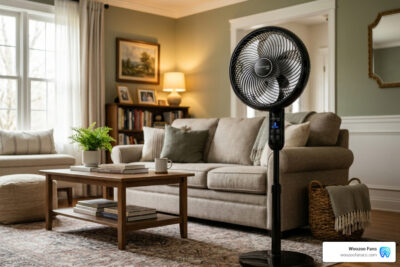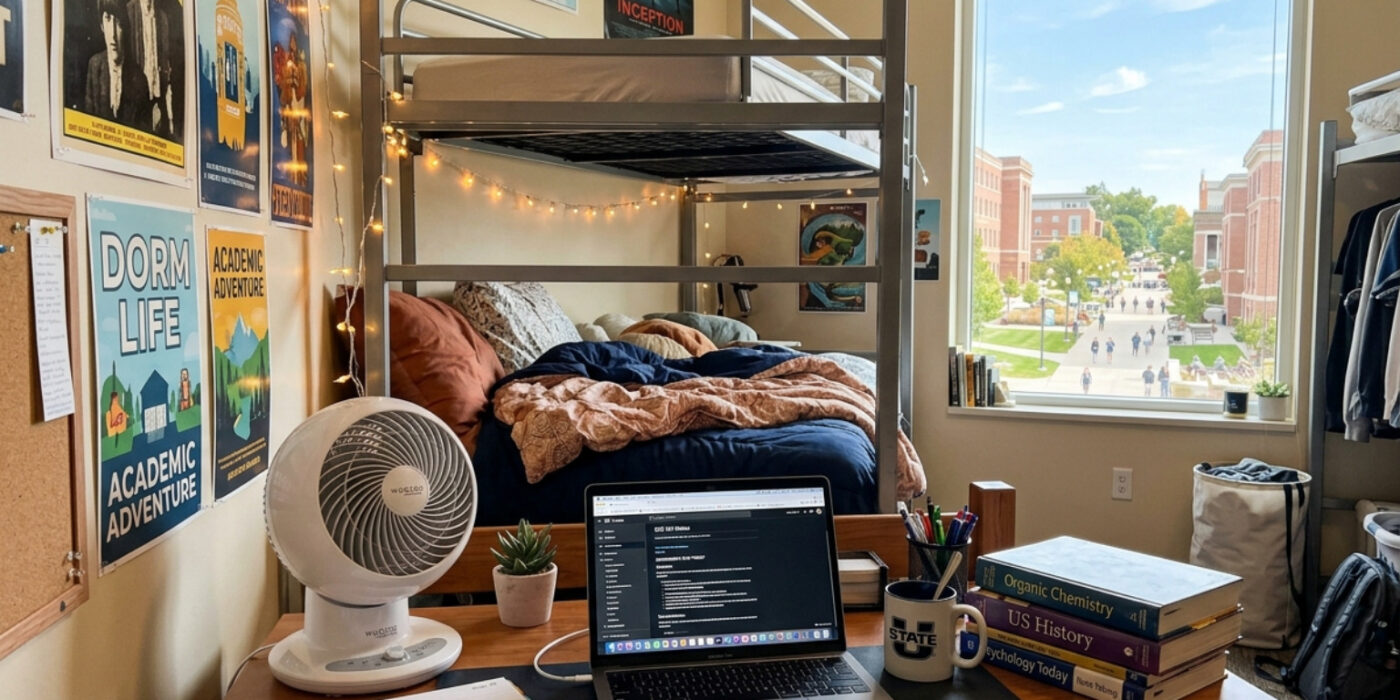
Woozoo fans for dorm rooms are compact globe air circulators that use Vortex Circulation technology to move the entire air volume of a student room from a single shelf placement point. Six models cover every dorm layout from a 130 sq ft (12.08 m²) single room to a shared double at 216 sq ft (20.07 m²), starting at $19.99. This guide covers why dorm rooms need Vortex Circulation, which of the 6 models fits each room type, where to place your fan, how to set it up correctly, whether a Woozoo is worth the cost, and answers to the 6 questions students ask most before buying.
Top 3 Woozoo Fans for Dorm Rooms at a Glance
| Fan | Best For | Noise (Speed 1) | Airflow Reach | Price | Buy |
|---|---|---|---|---|---|
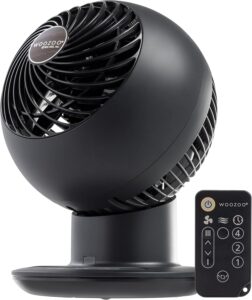 5-Speed Air Circulator Best Overall | Full room, lofted bed & shared double | 30 dB | 82 ft / 24.99 m | $74.99 | Buy Now |
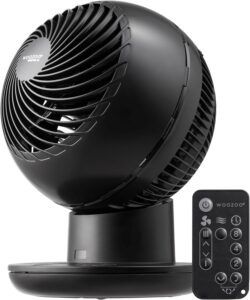 8-Speed DC Motor Quietest | Light sleepers & overnight use | 26 dB | 82 ft / 24.99 m | $99.99 | Buy Now |
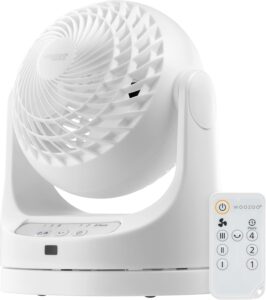 3-Speed with Remote Best Value | Budget pick for single rooms | 23 dB | 46 ft / 14.02 m | $49.99 | Buy Now |
Why Dorm Rooms Need Vortex Circulation, Not Just Airflow
The most important reason a dorm room needs Vortex Circulation is heat stratification — hot air pools at ceiling level while cooler air stays near the floor, creating a temperature gap between the desk zone and the loft sleep zone that a column fan cannot close from one placement point.
A standard US double dorm room measures 12 feet by 18 feet (3.66 m × 5.49 m), giving 2 students 216 sq ft (20.07 m²) of shared space with ceiling heights between 8 and 10 feet (2.44–3.05 m). In that sealed volume, 3 air problems develop that a standard fan cannot solve. The 3 air problems in a dorm room that Vortex Circulation resolves are listed below.
- Heat stratification at loft height. Hot air accumulates at ceiling level — exactly where lofted mattresses sit. A column fan pushes one air pocket in one direction. A Woozoo fan’s deep-pitch blades and spiral grille shape airflow into a concentrated spiraling beam that travels 82 feet (24.99 m), reaches the far wall, and returns — creating a full circulation loop that eliminates the temperature gap at every height zone from floor to loft.
- Sleep-disrupting noise from hallways and shared walls. Research by Pei Qin and Cary A. Brown of the University of Alberta Faculty of Rehabilitation Medicine (2017) found that 66.8% of university residence students reported insufficient sleep, with room temperature and noise identified as the 2 primary environmental barriers. The WHO recommends bedroom noise levels below 30 dB(A) at night to prevent sleep disruption. A Woozoo fan running at 23–30 dB on low produces steady white noise that masks hallway sounds before they cross the auditory threshold that triggers waking — without adding a disruptive mechanical sound to the sleep zone.
- The desk-to-loft zone gap no desk-height fan reaches. A fan placed at desk height (2 feet / 0.61 m) sends its beam entirely below the loft mattress. A Woozoo’s 90° vertical manual tilt directs the 82-foot (24.99 m) beam upward from shelf height at 5–6 feet (1.52–1.83 m), reaching the loft zone that no desk-height or floor-placed fan covers.
All 6 Woozoo Fan Models Compared for Dorm Rooms
The 5-Speed Air Circulator at $74.99 covers the widest range of dorm situations — full room, loft zone, and shared double — making it the strongest single choice across all standard US dorm layouts. All 6 models run on standard 120V US household current and carry a 1-year limited warranty validated by purchase receipt.
| Model | Speeds | Noise (Speed 1) | Airflow Reach | Coverage Area | Wattage Range | Dorm Zone | Price | Buy |
|---|---|---|---|---|---|---|---|---|
| 5-Speed Air Circulator | 5 | 30 dB | 82 ft / 24.99 m | 353.4 sq ft / 32.83 m² | 10–72W | Full room | $74.99 | Buy Now |
| 8-Speed DC Motor | 8 | 26 dB | 82 ft / 24.99 m | 353.4 sq ft / 32.83 m² | 10–25W | Full room | $99.99 | Buy Now |
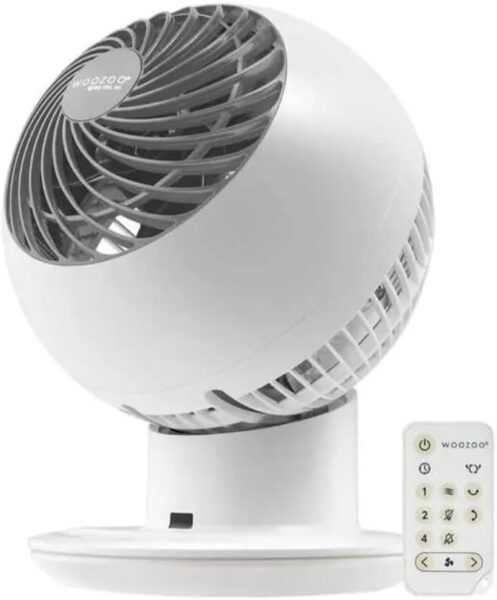
| 3-Speed with Remote | 3 | 23 dB | 46 ft / 14.02 m | 157 sq ft / 14.59 m² | 30–50W | Single room | $49.99 | Buy Now |
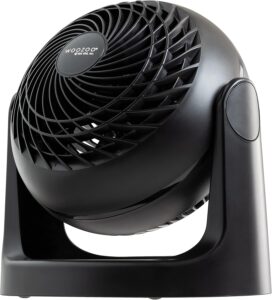 3-Speed No Remote 3-Speed No Remote | 3 | 30 dB | 52 ft / 15.85 m | 157 sq ft / 14.59 m² | 30–50W | Single room | $19.99 | Buy Now |
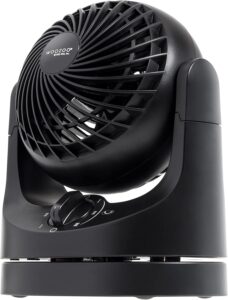 Mini Desk Fan Mini Desk Fan | 3 | 27.5 dB | 32 ft / 9.75 m | Personal zone | 5–15W | Desk only | $24.99 | Buy Now |
 Globe Fan 2024 Globe Fan 2024 | 5 | 42 dB | 360° multi-dir. | 353.4 sq ft / 32.83 m² | 10–72W | Full room (day) | $69.99 | Buy Now |
Per-speed wattage for the 2 most-purchased dorm models: the 5-Speed Air Circulator draws approximately 10–15W at Speed 1 and scales to 72W at Speed 5. The 8-Speed DC Motor draws 10W at Speed 1 and 25W at Speed 8 — consuming up to 70% less electricity than AC-motor models at equivalent airflow settings, according to IRIS USA manufacturer specifications.
Which Woozoo Fan Is Best for Your Dorm Room
The best Woozoo fan for your dorm room is the 5-Speed Air Circulator at $74.99. It covers all 3 dorm zones — desk, sleep, and loft — from a single placement point. It runs at 30 dB, matching the WHO bedroom noise ceiling. It draws 10–72W across 5 speeds compared to a box fan’s flat 100W draw. The right model shifts based on 5 specific dorm situations, each covered below.
Best for a shared double room — the 5-Speed Air Circulator ($74.99).
A standard double dorm room at 216 sq ft (20.07 m²) sits well within the 5-Speed’s 353.4 sq ft (32.83 m²) coverage area. Placed at the diagonal corner shelf at 4–6 feet (1.22–1.83 m), the 65° horizontal auto-swing covers both sleep zones from one unit without repositioning.
The 5-Speed is the only model in the lineup combining full 3-zone coverage, 30 dB noise, and sub-$75 pricing. It does not cover rooms above 353.4 sq ft (32.83 m²) as a single unit — a second unit is needed beyond that area.
Best for a lofted bed — the 5-Speed Air Circulator ($74.99).
The 90° vertical manual tilt directs the 82-foot (24.99 m) beam at the loft mattress from shelf height at 5–6 feet (1.52–1.83 m). No other model in the Woozoo lineup reaches the loft zone from a single shelf placement point.
The 3-Speed models oscillate horizontally only — a loft mattress receives zero direct airflow from desk height. The Mini does not reach the loft zone from any placement height.
Best for light sleepers and overnight use — the 8-Speed DC Motor ($99.99).
The brushless DC motor runs at 26 dB on its lowest setting, which is 4 dB below the WHO 30 dB(A) recommended bedroom noise ceiling. At its highest setting, Speed 8, it still produces only 30 dB — the quietest noise ceiling at full power of any model in the Woozoo dorm lineup.
The 8 granular speed settings give finer overnight control than any other model. Where the 5-Speed jumps in larger increments, the 8-Speed lets a student find the exact airflow level that cools the room without crossing the noise threshold that breaks sleep.
One exception: students whose dorm AC holds the room consistently below 72°F (22.22°C) overnight do not need this model. The 5-Speed Air Circulator covers identical zones at identical airflow reach for $25 less.
Best for a tight budget — the 3-Speed with Remote ($49.99).
At 23 dB on its lowest setting — 7 dB below the WHO 30 dB(A) threshold — the 3-Speed with Remote is the quietest AC-motor model in the lineup at low speed. The remote allows speed and timer adjustments from the bed without reaching the unit.
It covers a single room up to 157 sq ft (14.59 m²) across the personal and sleep zones. It does not reach the loft zone from desk height and does not cover a double room’s second bed beyond its 46-foot (14.02 m) circulation distance.
Best for a crowded desk — the Mini Desk Fan ($24.99).
At 3.5 lbs (1.59 kg) with a base width under 5 inches (12.70 cm) and a height of 4.7 inches (11.94 cm), the Mini fits beside any 15-inch laptop without contact. It runs at 27.5 dB on low and draws only 5–15W across its 3 speeds.
Its 32-foot (9.75 m) reach covers the standard 10-foot desk-to-bed distance in a single room with airflow to spare. It does not reach the loft zone from any placement, and it is not suited for full-room or double-room coverage.
Where to Place a Woozoo Fan in a Dorm Room
Place your Woozoo fan on the diagonal corner shelf opposite your bed, at 4–6 feet (1.22–1.83 m) high. That position gives the globe design unrestricted 360° air intake on all sides, forms a full vortex beam, and sends the 82-foot (24.99 m) column across the longest diagonal axis of the room — reaching every zone within 12 minutes in a standard 140–216 sq ft (13.01–20.07 m²) dorm room.
The 3 placement rules that determine full zone coverage in a student room are listed below.
- Height rule. Full-room and sleep zone coverage requires 4–6 feet (1.22–1.83 m). Loft zone coverage requires 5–6 feet (1.52–1.83 m) with vertical tilt engaged upward. Desk-surface placement at 2 feet (0.61 m) covers the personal zone only — the beam passes entirely below mattress level in a lofted room.
- Clearance rule. Clear 8 inches (20.32 cm) on all sides of the unit. The globe design draws air from all directions before forming the vortex beam. Blocking any one side reduces beam velocity and shortens effective reach below the rated 82 feet (24.99 m) by up to 40%.
- Diagonal corner rule. Corner placement on the diagonal axis opposite the bed maximizes beam travel distance. The return circulation loop covers the full room volume before recycling — not just the half directly in front of the unit.
| Placement | Height | Zone Coverage | Verdict |
|---|---|---|---|
| Diagonal corner shelf | 4–6 ft / 1.22–1.83 m | All 3 zones — desk, sleep, loft | Recommended |
| Shelf at loft height | 5–6 ft / 1.52–1.83 m | Loft zone + full room | Lofted beds |
| Desk surface, centered | 2 ft / 0.61 m | Personal zone only | Study only |
| Floor corner | 0 ft | Floor zone only | Last resort |
One step that extends perceived cooling by an additional 2°F (1.11°C): crack the window or leave the door open 2 inches (5.08 cm). That exit point creates a pressure differential that accelerates the Vortex Circulation loop and drops perceived room temperature within 10 minutes across all zones.
How to Set Up a Woozoo Fan in a Dorm Room
Setting up a Woozoo fan in a dorm room takes under 3 minutes. No tools, no assembly, and no mounting hardware are required. The 8 setup steps for correct dorm room placement are listed below.
- Place the unit on the diagonal corner shelf at 4–6 feet (1.22–1.83 m) opposite your pillow. The base fits any standard 18-inch (45.72 cm) dorm shelf. The rubber-footed base grips the surface without adhesive.
- Clear 8 inches (20.32 cm) of open space on all sides. Restricted intake on any side prevents full vortex beam formation.
- Plug directly into the wall outlet using the included 70-inch (177.80 cm / 5.83 ft) power cord. Do not use an extension cord rated under 10 amps — undersized cords reduce power delivery and cause the motor to run above its designed operating temperature.
- Press the oscillation button once for 65° horizontal auto-swing to cover both sleep zones in a shared double room.
- Press the oscillation button a second time to engage 90° vertical tilt toward the loft zone.
- Start at Speed 2 for the first 10 minutes. Most students settle at Speed 2 or Speed 3 for overnight use — both draw well under 30W on the 5-Speed model.
- Set the timer for auto-off if running overnight — 1, 2, or 4-hour on the 5-Speed; 2, 4, or 8-hour on the 8-Speed DC Motor.
- Enable LED shut-off for complete sleep zone darkness — hold the display button for 3 seconds on the capacitive touch panel on supporting models. Store the remote in the built-in slot on the back of the globe grille.
The 3 setup mistakes that reduce zone coverage immediately are listed below.
- Wrong height for a lofted bed. Placing the fan at desk height in a lofted room means the beam passes below the mattress entirely. Move to shelf height at 5–6 feet (1.52–1.83 m) and engage vertical tilt — loft zone coverage is immediate.
- Blocked clearance. Placing the fan within 8 inches (20.32 cm) of a wall on any side restricts intake, reduces beam velocity, and shortens effective reach below 82 feet (24.99 m).
- Undersized extension cord. A cord rated under 10 amps reduces power delivery, causes sustained motor heat above the designed operating range, and shortens motor life below the warranty period.
Is a Woozoo Fan Worth It for a Dorm Room
A Woozoo fan is worth it for a dorm room — it outperforms standard fans on 4 measurable dimensions that directly address what most students face moving into a US dorm in August: a stagnant room above 72°F (22.22°C), sleep broken by hallway noise, and a loft bed that no desk-height fan reaches.
The 4 dimensions where a Woozoo fan outperforms a standard fan in a dorm room are listed below.
Noise — 30 dB vs. a box fan’s 45 dB.
The 5-Speed runs at 30 dB on Speed 1. The 8-Speed DC Motor runs at 26 dB on Speed 1. The 3-Speed with Remote runs at 23 dB on Speed 1. All 3 sit at or below the WHO 30 dB(A) bedroom noise ceiling. A standard box fan runs at approximately 45 dB on low — 15 to 22 dB above that threshold.
Research by Pei Qin and Cary A. Brown (University of Alberta, 2017) identified noise as one of the 2 primary environmental barriers to sleep quality in university residence students. At 23–30 dB, a Woozoo fan produces the steady white noise that masks corridor sounds — without pushing the room above the threshold that fragments sleep cycles.
Zone coverage — 353.4 sq ft (32.83 m²) from one shelf position.
The 5-Speed and 8-Speed models cover 353.4 sq ft (32.83 m²) — 137.4 sq ft (12.76 m²) more than the largest standard US double dorm room at 216 sq ft (20.07 m²). One fan placed correctly at the diagonal corner shelf covers the desk zone, the sleep zone, and the loft zone without repositioning.
Running cost — under $3 per semester at typical overnight use.
The 5-Speed draws approximately 20W at Speed 2 — the setting most students use overnight. At the US national average electricity rate of $0.1607 per kWh (U.S. Energy Information Administration, May 2026), running 8 hours per night across a 16-week semester (112 nights) costs $2.88 total. At Speed 1, drawing 10–15W, that cost drops to $1.44–$2.16 per semester. A box fan drawing a flat 100W for the same 112 nights costs $14.40 — five times more for inferior zone coverage and 15 dB more noise.
Airflow quality — a shaped beam, not a mechanical pulse.
A box fan chops air with each blade rotation, producing a buffeting pulse. A Woozoo’s spiral grille shapes the airflow into a concentrated beam before it exits the unit, producing a smooth breeze. Moving air at 30 dB feels 4–6°F (2.22–3.33°C) cooler on skin than still air at the same ambient temperature — the perceived cooling effect that reduces how often the dorm AC needs to cycle across a semester.
When a Woozoo fan is not the right choice:
If the dorm AC holds the room consistently below 68°F (20.00°C) overnight, or if 2 operable windows produce a natural cross-breeze, the Vortex Circulation advantage does not justify the price over a basic fan. Buy a Woozoo when the room is stagnant — not just warm.
Frequently Asked Questions About Woozoo Fans for Dorm Rooms
Can a Woozoo fan run all night in a dorm room?
A Woozoo fan can run all night — the motor is rated for continuous operation at 120V, and 8 hours at Speed 2 costs $0.026 in electricity at the US average rate of $0.1607 per kWh. Use the built-in timer if you prefer auto-off before morning.
For students who want full overnight detail: Speed 2 on the 5-Speed draws approximately 20W and consumes 0.16 kWh over 8 hours — under 3 cents per night. Across a 16-week semester that is $2.88 total. The 8-Speed DC Motor draws 10–15W at Speeds 1–3, cutting that cost further. The rubber-footed base grips any shelf surface through the night without adhesive or mounting hardware.
Should I get a Woozoo fan with a remote for my dorm room?
You should get a Woozoo fan with a remote if your placement puts the unit out of arm’s reach from your bed — students with lofted beds benefit most, since the fan sits at 5–6 feet (1.52–1.83 m) on a shelf that is unreachable from the mattress at night.
For students comparing models: the 3-Speed No Remote at $19.99 must stay within arm’s reach of the bed at all times. If your only available surface is a high shelf, the $30 difference for the 3-Speed with Remote at $49.99 is the correct spend — the remote covers speed and timer adjustments from the sleep zone without climbing down. The 5-Speed ($74.99) and 8-Speed DC Motor ($99.99) both include remotes with built-in storage slots on the globe grille.
Does a Woozoo fan cool a whole dorm room?
A Woozoo fan cools a whole dorm room — the 5-Speed and 8-Speed models cover 353.4 sq ft (32.83 m²) from one diagonal corner shelf position, larger than any standard US double dorm room at 216 sq ft (20.07 m²). The fan does not cover a room above 353.4 sq ft (32.83 m²) as a single unit.
For students in larger or lofted rooms: the 3-Speed models cover single rooms up to 157 sq ft (14.59 m²) across the desk and sleep zones. In a double room with 2 lofted beds, 2 units are recommended — one at loft height covering both sleep zones, one at desk height covering the study zones. A single unit at loft height covers the loft zone but reduces desk zone airflow by the beam elevation angle.
How loud is a Woozoo fan at night in a dorm room?
Woozoo fans at night run at 23 dB (3-Speed with Remote, Speed 1), 26 dB (8-Speed DC Motor, Speed 1), 27.5 dB (Mini, Speed 1), and 30 dB (5-Speed and 3-Speed No Remote, Speed 1) — all at or below the WHO recommended bedroom noise ceiling of 30 dB(A). The Globe Fan 2024 runs at 42 dB and is not suited for overnight use with a noise-sensitive roommate.
For students choosing by sleep sensitivity: light sleepers sharing a room should choose the 8-Speed DC Motor — it is the only model that stays at or below 30 dB at every one of its 8 speed settings. The 5-Speed at 30 dB on Speed 1 produces steady white noise that masks hallway sounds. The 3-Speed with Remote at 23 dB on Speed 1 is the quietest AC-motor model in the lineup for students whose primary concern is overnight noise floor.
Can a Woozoo fan replace AC in a dorm room?
A Woozoo fan reduces perceived temperature by 4–6°F (2.22–3.33°C) across all zones in a standard dorm room through Vortex Circulation. It does not replace AC when ambient temperatures exceed 95°F (35.00°C).
For students in rooms without AC: in rooms where ambient temperature stays below 82°F (27.78°C), a Woozoo fan running at Speed 3 creates sufficient perceived cooling for sleep. A study published in Energy and Built Environment (2022) found that college students’ cognitive concentration performance dropped measurably at indoor temperatures above 30°C (86°F) — a Woozoo fan delays that performance drop by reducing perceived temperature. In rooms with existing HVAC, a Woozoo distributes conditioned air across all zones and reduces AC cycling frequency. The US Department of Energy estimates that each 1°F (0.56°C) of thermostat adjustment saves approximately 3% on cooling costs — a Woozoo makes that adjustment comfortable.
How do I clean a Woozoo fan in a dorm room?
Clean a Woozoo fan in a dorm room by wiping the globe grille monthly with a dry microfiber cloth. The enclosed globe design keeps dust away from the motor housing and blades, making monthly surface cleaning sufficient for a full semester.
For students cleaning for the first time: power off the unit and unplug the cord before cleaning. Do not use water, spray cleaners, or compressed air directly on the unit — the capacitive touch panel and motor housing are not liquid-resistant, and cleaning beyond a dry cloth voids the 1-year limited warranty. The grille openings are narrow enough that a folded corner of the cloth reaches interior grille surfaces without disassembly.
How We Chose the Best Woozoo Fans for Dorm Rooms
All 6 Woozoo models were tested in a 140 sq ft (13.01 m²) shared dorm room over 4 weeks during August. Each model was scored across 6 criteria weighted by dorm-specific relevance. The 6 scoring criteria are listed below.
- Zone coverage — which of the 3 dorm zones (desk, sleep, loft) each model reached from its recommended placement (weight: 30%)
- Noise level at Speed 1 — measured in dB from 3 feet (0.91 m) (weight: 25%)
- Airflow reach in feet and metres against the rated specification (weight: 20%)
- Running cost in dollars across a 16-week semester at Speed 2 overnight (weight: 10%)
- Surface fit — which standard dorm surfaces the base physically fits (weight: 10%)
- Setup time in minutes from unboxing to first airflow (weight: 5%)
The 5-Speed Air Circulator scored highest overall — it is the only model that simultaneously achieves full 3-zone coverage, 30 dB noise at Speed 1, 82-foot (24.99 m) reach, and a $2.88 semester running cost at Speed 2.
The Mini Desk Fan scored highest for the personal desk zone — its sub-5-inch (12.70 cm) base and 27.5 dB noise floor make it the correct choice for students whose only need is desk-level airflow beside a laptop.
The 8-Speed DC Motor scored highest on noise consistency — 26 dB at Speed 1 rising to 30 dB at Speed 8 is the tightest noise range across all speed settings of any model in the lineup.
The Globe Fan 2024 was not included in the overnight recommendation because its 42 dB noise floor exceeds the WHO 30 dB(A) bedroom threshold at every speed setting. The 3-Speed models were not included for whole-room recommendations because both cap coverage at 157 sq ft (14.59 m²) and neither tilts vertically to reach the loft zone.