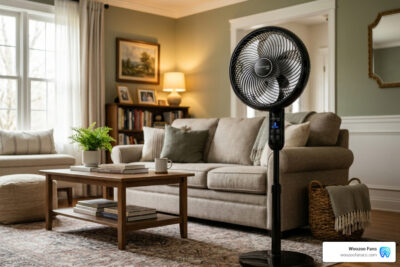
Quick answer: Buy the PCF-SC15T if you want the best overall Woozoo fan. Buy the PCF-SDS15T if quiet sleep matters most. Buy the STF-360DC-N if you need standing height and wide-room coverage. Buy the PCF-SC12 if your budget ceiling is under $50.
Best Woozoo Fan Ranked List
The best Woozoo fan ranked list starts with the PCF-SC15T because it combines 82ft airflow, 353 square feet of official coverage, and quiet low-speed operation in a compact globe design.
| Rank | Model | Best for | Why it stands out | Main trade-off |
|---|---|---|---|---|
| 1 | Woozoo 5-Speed Globe Fan PCF-SC15T | Best overall | 82 feet away air projection, 353 sq ft coverage, quiet 28 dB low setting, compact footprint | Usually costs more than the entry model |
| 2 | Woozoo 8-Speed Desk Fan PCF-SDS15T | Best for bedrooms | 22 dB low setting, 120 degree horizontal oscillation, 8 speed granularity | Less well-known than the flagship globe model |
| 3 | Woozoo 360 Pedestal Fan STF-360DC-N | Best for large shared rooms | Standing height, 12 speeds, 322.9 sq ft coverage, room-wide circulation | Takes more floor space |
| 4 | Woozoo 3-Speed Globe Fan PCF-SC12 | Best under $50 | Compact 7.09 x 7.09 x 9.84 inch body, 36 W draw, 52 to 56 ft reach, low entry price | Only 3 speeds and less airflow headroom |
| 5 | Personal and Macaron Series | Best for desks and nightstands | Small footprint and easy portability | Not strong enough for whole-room use |
The ranked answer leads to one clear buying rule. Choose the PCF-SC15T if you want the most complete air circulator fan in the Woozoo line. Choose a different model only if you have a narrower use case.
Which Woozoo Model Is Quietest?
The quietest Woozoo model in the data set is the PCF-SDS15T at 22 dB on low. The PCF-SC15T follows at 28 dB on low, which is still bedroom-friendly.
This matters because quietness is the biggest divider between a bedroom fan and a living-room fan. A model can circulate air well and still feel annoying at night.
| Model | Low-speed noise | Noise position | Best use |
|---|---|---|---|
| PCF-SDS15T | 22 dB | Quietest listed model | Sleep, nursery, quiet desk work |
| PCF-SC15T | 28 dB | Very quiet | Bedroom, office, general use |
| Bedroom-oriented Woozoo claims | 17 to 30 dB range | Brand-level range | Low-speed nighttime circulation |
| PCF-SC12 | No verified dB figure in collected data | Unclear | Budget buyers who accept spec gaps |
The quietest Woozoo fan for sleeping is the SDS-15T. The best quiet Woozoo fan that still feels like a whole-room pick is the PCF-SC15T. That distinction sets up the coverage question next.
Which Woozoo Fan Covers the Most Square Footage?
The Woozoo fan that covers the most square footage is the 5-Speed Globe Fan with an official rating of 353 square feet. The 360 Pedestal Fan follows at 322.9 square feet.
The 5-Speed Globe Fan also carries the biggest headline throw claim in the lineup. Brand and retailer data say the fan can project air up to 82 feet away. That 82ft airflow claim is impressive, but owner feedback suggests comfortable personal cooling happens at shorter real-world distances.
| Model | Official coverage | Air distance | Coverage takeaway |
|---|---|---|---|
| PCF-SC15T | 353 sq ft | 82 ft | Strongest all-around whole-room option |
| STF-360DC-N | 322.9 sq ft | Not listed in collected data | Best standing option for shared spaces |
| PCF-SC12 | No official room-size figure in collected data | 52 to 56 ft | Better for smaller rooms and desks |
| BC-15 | No official room-size figure in collected data | 56 ft | Compact use, not a flagship room mover |
Expectation check: The vortex circulation technology in Woozoo fans is designed for room mixing, not a harsh single-direction blast. Reddit owners who also use Vornado fans often report that Woozoo feels softer at long distance even when the paper spec looks strong.
Woozoo Model Number Decoder: Globe, Pedestal, Desk, and What They Actually Mean
The Woozoo model number decoder matters because many buyers know the marketing name but not the SKU. That mismatch creates confusion when prices, warranties, and reviews do not line up.
| Marketing name | Model number | Type | What it means in practice |
|---|---|---|---|
| 5-Speed Globe Fan | PCF-SC15T | Globe air circulator fan | Flagship spherical model with the best overall mix of throw, quietness, and coverage |
| 3-Speed Globe or Desk Fan | PCF-SC12 | Compact desk circulator | Entry-level Woozoo pick with smaller size, lower price, and lighter output |
| 8-Speed Desk Fan | PCF-SDS15T | Desk and bedroom circulator | Quietest listed option with broader horizontal oscillation |
| 360 Pedestal Fan | STF-360DC-N | Standing circulator fan | Tall format with 12 speeds and wider-room coverage |
| BC-15 Compact Model | BC-15 | Compact desk fan | Small body with 56 ft throw claim and basic 3-speed control |
Model number clarity solves a second problem. It makes retailer comparison easier because Costco, Amazon, and Walmart do not always use the same product naming style. That naming issue leads straight into price comparison.
How Much Does the Best Woozoo Fan Cost Right Now?
The best Woozoo fan costs about $74.99 to $99.99 in the 2026 data you provided. That range applies to the 5-Speed Globe Fan, which is the best overall pick.
| Retailer | Model | Observed price | Price note |
|---|---|---|---|
| Costco | STF-360DC-N 360 Pedestal Fan | $79.99 | Includes free shipping in collected 2026 listing |
| Woozoo direct and brand listings | Lineup range | $74.99 to $99.99 | Typical range for flagship models |
| Walmart | 3-Speed Oscillating model | $39.97 | Best budget listing in your data set |
| Amazon | Comparable 3-Speed model | Up to $69.99 | Surge pricing and third-party markup appear in peak season |
| Amazon Prime Day | Desk fan listing | $80 | Discounted from a higher normal listing |
The best Woozoo fan price is usually not the most stable Woozoo price. Costco and Walmart tend to look cleaner. Amazon tends to swing harder during heat waves and high-demand weeks.
What about energy cost?
Woozoo running cost depends on motor type, wattage, and how many hours you use it per day. The brand-level power range in your data spans from 5 watts to 72 watts, and the PCF-SC12 is listed at 36 watts.
Use this formula to estimate your monthly cost: (watts / 1000) x hours per day x 30 x your electric rate. DC-motor Woozoo models should cost less to run than comparable AC models because the brand claims up to 70 percent energy savings on DC units.
Is the Woozoo Fan Worth It Compared to a Vornado?
The Woozoo fan is worth it compared to a Vornado if you want quieter operation, a smaller footprint, and softer room circulation. A Vornado is still the stronger pick if you want maximum range and stronger air volume.
| Category | Woozoo | Vornado |
|---|---|---|
| Air style | Vortex circulation technology with softer room-mixing feel | Stronger long-throw circulation feel |
| Noise feel | Often quieter on low settings | Can feel louder but stronger |
| Footprint | Smaller and easier to place on desks or shelves | Usually bulkier at similar performance tiers |
| Best buyer type | Bedroom, dorm, desk, and compact-room buyers | Open-room and long-throw buyers |
| Main weakness | Owner complaints on durability and remote quirks appear more often | Less cute, less compact, and sometimes less quiet |
Reasons to choose Woozoo
- Smaller physical footprint
- Very quiet low-speed settings
- Good desk and bedroom fit
- Attractive spherical design
Reasons to choose Vornado
- Stronger air volume at distance
- Better reputation for pure circulation power
- More suitable near open windows and vent pushing
- Fewer expectations gaps on reach
Reddit sentiment in your research set lands in the middle. Some owners say their Woozoo fans still work perfectly after three years. Other owners say they would keep one only as a secondary fan and would still choose Vornado as their main room circulator.
Best Woozoo Fan for Bedroom vs. Living Room vs. Dorm
The best Woozoo fan for a bedroom is the PCF-SDS15T. The best Woozoo fan for a living room is the PCF-SC15T or the STF-360DC-N. The best Woozoo fan for a dorm is the PCF-SC12.
| Use case | Best model | Why it wins |
|---|---|---|
| Bedroom or nursery | PCF-SDS15T | 22 dB low speed and wide 120 degree oscillation support low-noise overnight use |
| Large living room | PCF-SC15T | 353 sq ft rating and 82 ft throw claim make it the strongest compact all-around option |
| Shared family room | STF-360DC-N | Standing height and 12 speeds help distribute air across more of the room |
| Dorm room | PCF-SC12 | Compact body, lighter weight, and lower price make it easier to move and store |
| Office desk | PCF-SDS15T or Personal Series | Quiet output and small footprint suit work surfaces |
The best Woozoo fan for your room depends on one main question. Do you need quiet air near your body or stronger air mixing across the room? That difference decides whether you buy the bedroom model or the flagship model.
Does the Woozoo Fan Really Reduce Your AC Costs?
A Woozoo fan can help reduce AC dependence by moving cooled air more evenly across a room, but the cost-savings claim is not independently lab-verified in the data collected for this page.
This is the right way to frame the claim. A Woozoo does not lower room temperature the way an air conditioner does. A Woozoo redistributes existing cooled air through an air circulator fan pattern.
That redistribution can make a room feel more evenly cooled. That effect can let some users raise the thermostat a little. The exact savings number still depends on climate, room size, insulation, and fan placement.
Practical use: Put a Woozoo near the AC output path, not in a random corner. Vortex circulation technology works best when the fan has room to mix existing air rather than push against blocked furniture.
Airflow placement leads to a harder question. Buyers also want to know what goes wrong after a year or two, not just what works on day one.
Common Woozoo Problems Owners Do Not Tell You: Remote Interference, Early Failures, and Warranty Confusion
Common Woozoo problems in owner discussions include remote interference with TVs, early fan failures after a few years, and unclear warranty language across retailers.
| Issue | What owners report | What it means before you buy |
|---|---|---|
| Remote interference | Some owners say the fan remote can trigger or partially control a TV | Check placement if your fan will sit near a television or media console |
| Durability drop-off | Some owners report failure after two Woozoo purchases or after a few years | Do not assume the cute design equals premium long-term durability |
| Performance mismatch | Some buyers say the airflow feels weaker than Vornado at long distance | Buy Woozoo for mixed-room comfort, not for the most aggressive blast |
| Warranty confusion | Some listings show 1 year while Costco-related listings show 5 years | Verify the channel-specific warranty before checkout |
How to interpret the warranty conflict
The Woozoo warranty is not described consistently across the 2026 research set. General retail listings often show a 1-year baseline warranty, while Costco-related listings can show 5 years.
The safest buying move is simple. Treat the warranty as retailer-specific until the exact SKU page confirms the term in writing.
Basic maintenance steps
To clean a Woozoo fan, unplug the unit, remove surface dust from the grille, vacuum loose debris, and wipe the housing with a dry or lightly damp cloth. To deep clean a Woozoo fan grille, follow the model manual before disassembling any front cover.
To troubleshoot a Woozoo fan that stopped working, test the outlet, replace the remote battery, power-cycle the fan, and inspect the grille for dust buildup. If the controls behave strangely, move the fan away from nearby electronics before assuming the motor failed.
Where to Buy the Best Woozoo Fan Model: Price Comparison Table
The best place to buy the best Woozoo fan model depends on whether you value the lowest price, the strongest warranty, or the cleanest return policy. Costco usually looks best for security. Walmart usually looks best for entry pricing. Amazon is the least predictable.
| Store | Best reason to buy there | Watch-out |
|---|---|---|
| Costco | Strong value and possible 5-year warranty on some listings | Selection can be seasonal and member-dependent |
| Walmart | Low price on entry models | Feature set can be lighter than flagship listings |
| Amazon | Fast shipping and broad availability | Third-party surge pricing can erase the value |
| Target | Reliable retail specs and easier in-store returns | Not always the lowest price |
| IRIS USA or Woozoo direct | Cleaner official naming and model reference | Price is not always better than warehouse retail |
The best time to buy a Woozoo fan is usually late winter or early spring. Summer demand spikes create the worst pricing noise, especially on Amazon marketplace listings.
Frequently Asked Questions About the Best Woozoo Fan Model
What is a Woozoo fan?
A Woozoo fan is a household air circulator fan made by IRIS USA and Iris Ohyama. It uses a globe-style design and vortex circulation technology to move air across a room rather than blast in one narrow line.
Is Woozoo a brand or a fan type?
Woozoo is a brand line, not a generic fan type. The fan type is best described as an air circulator or vortex fan.
What is the best Woozoo fan for bedroom use?
The best Woozoo fan for bedroom use is the PCF-SDS15T if you want the quietest low setting. The best bedroom Woozoo that still doubles as a whole-room fan is the PCF-SC15T.
What is the best Woozoo fan under $50?
The best Woozoo fan under $50 is usually the PCF-SC12. It has the strongest balance of compact size, basic oscillation, and low upfront price in the budget tier.
Is the Woozoo fan worth it?
The Woozoo fan is worth it if you value quiet operation, compact size, and soft whole-room circulation. It is less convincing if you want maximum throw power or top-tier long-term durability.
Which Woozoo fan model is best for large rooms?
The Woozoo fan model that is best for large rooms is the PCF-SC15T if you want the strongest compact globe fan. The STF-360DC-N is the better standing option if you want height and 12-speed control.
Does the Woozoo remote use a replaceable battery?
The Woozoo remote uses a replaceable battery, and battery replacement is one of the first troubleshooting steps when the controls stop responding. Always confirm the battery type in the manual for your exact model.